







Manufacturing businesses come in all shapes and sizes.
Some assemble products from bought-in components, some package and kit items together, while others run complex production processes involving multiple stages, machines and production lines.
When it comes to ERP, many assume they'll need a full manufacturing implementation. In reality, the functionality you need depends on how your business operates.
Before embarking on a complex manufacturing ERP project, it's worth asking a simple question: do you need full manufacturing functionality, or do you just need the right functionality?
Manufacturers don’t all operate in the same way, so it stands to reason that they don’t all need the same type of ERP project.
Some of the manufacturers we speak to work within, but are not limited to:
Different operations, different requirements. Before choosing your ERP project, it’s important to identify what type of manufacturer you are and whether your project provides the functionality you need.
Do you:
The answers can tell you a lot about the level of manufacturing functionality your business actually needs.
If you assemble and supply products, your ERP requirements may differ from a business managing multiple production stages, work centres and detailed shop floor scheduling.
Surely, manufacturing is manufacturing? Actually, it’s not that straightforward.
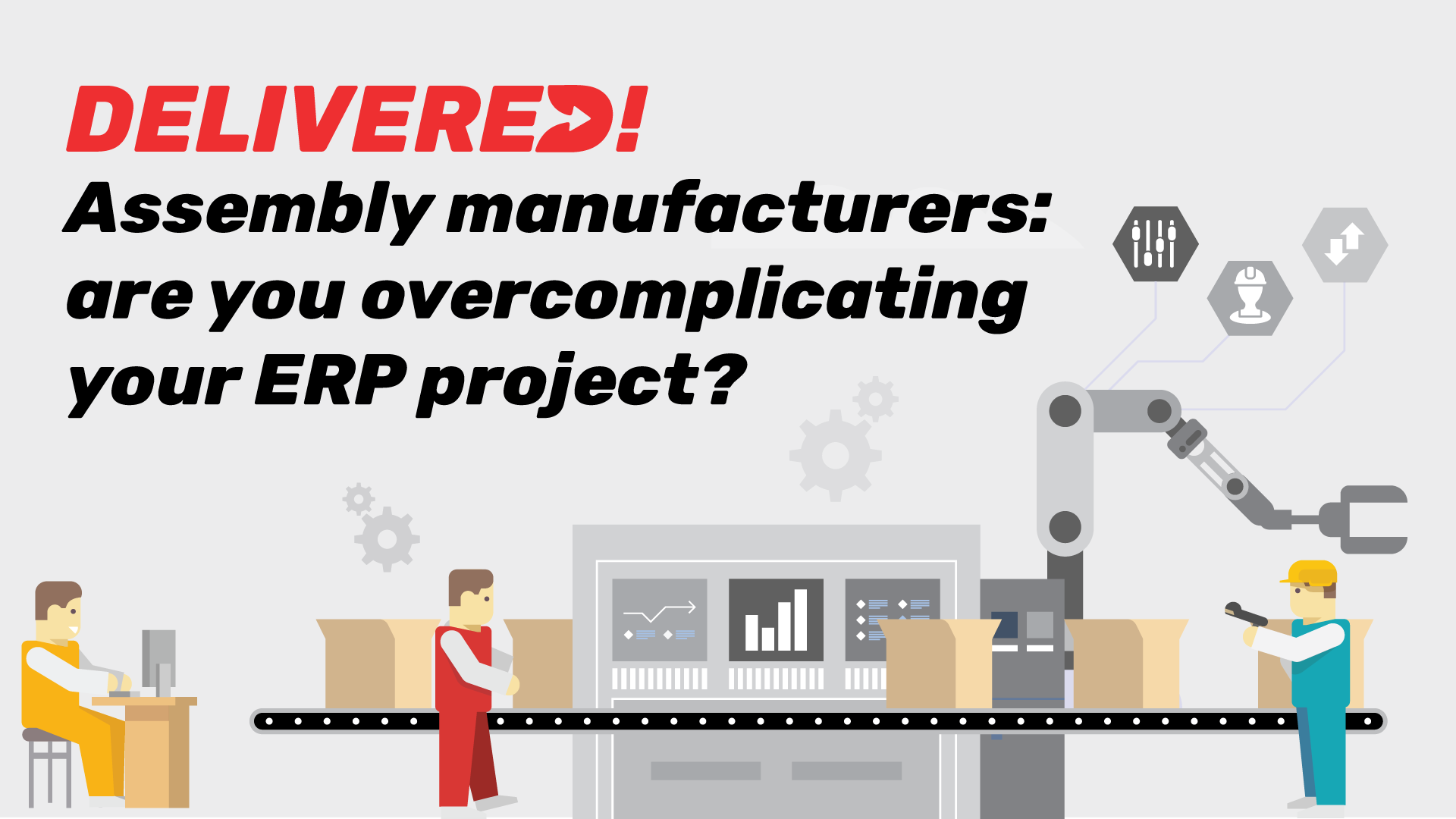
While assembly manufacturing falls under the broader manufacturing umbrella, the ERP requirements of an assembly-focused business can be very different from those of a manufacturer running more complex production processes.
Assembly operations often include managing components, inventory, customer demand and product assembly. Manufacturers with more complex production environments may also need capabilities such as routings, capacity planning, machine scheduling and shop-floor control.
Both are valid manufacturing models, but have different operational complexities and ERP requirements.
If your business primarily assembles finished goods from purchased components, it's worth considering whether functionality such as capacity planning, machine scheduling, detailed routings and production execution tracking will deliver value today.
If you're mainly looking for better stock control, improved traceability, accurate costing, less reliance on spreadsheets and greater visibility across the business, a fixed-scope ERP implementation may be a better fit for your assembly operation.
Not always. Many assembly manufacturers need inventory control, bills of materials, costing, traceability and order management rather than advanced production functionality such as capacity planning, routings and machine scheduling.
Most assembly manufacturers need:
Businesses can meet these requirements using Business Central's Assembly Management functionality, without implementing the full manufacturing module.
For some assembly manufacturers, a fixed-scope implementation approach such as Delivered! can provide access to this functionality without the complexity of a larger manufacturing-focused project.
Assembly manufacturers often need many of the same benefits as other manufacturers: inventory control, cost visibility, traceability, accurate purchasing and confidence that customer orders can be fulfilled on time.
Microsoft Dynamics 365 Business Central supports these requirements through its Assembly Management capabilities, which are available as an optional Assembly Management extra pack within Delivered! – Tecman’s fixed ERP implementation approach to Business Central.
Using Assembly Bills of Materials (BOMs) and Assembly Orders, businesses can define how finished products are built from component parts, maintain accurate stock levels and gain better visibility into material usage and product costs. This gives teams a clearer understanding of what is required to fulfil customer demand, without the complexity of a full production environment.
Business Central supports two common assembly scenarios:
Assemble to Stock is ideal for standard products that are regularly sold and held in inventory. Businesses can create assembly orders manually or through planning processes to help maintain target stock levels, ensuring products are available when customers need them.
Assemble to Order is designed for products that are built specifically for a customer order. Assembly Orders can be linked directly to Sales Orders, so products are only assembled when required.
Alongside assembly management, assemblers can get the wider ERP capabilities from Business Central, including:
For many assembly manufacturers, this functionality gets them away from spreadsheets and establishes more structured processes, without immediately introducing advanced manufacturing features they may not require.
For some businesses, a traditional ERP project is the right approach, particularly where manufacturing processes are complex or highly specialised.
For assembly-focused businesses with more straightforward requirements, a fixed-scope implementation can offer a faster route to Business Central while still delivering the visibility, control and operational improvements they are looking for.
Delivered! is designed around this principle, helping businesses adopt core ERP functionality without all the bells and whistles they may not need today.
At the end of the day, the right ERP project and system isn’t always the one with the most functionality. It’s about looking at your business operations and deciding whether now’s the time for complexity, or whether a simpler approach that gives you the capabilities you need today might be what you need to get you on your ERP journey.
Want to talk to a member of the Tecman team to find out if Delivered! can work for you?